
What’s Your Teaching Specialty?

Last year I had a student, I’ll call him James, who was becoming quite advanced (I had been teaching him since he was little) and came to every lesson with a new, difficult piece of repertoire he wanted to learn. First, it was Clair de lune. Then the Moonlight Sonata (3rd movt!). Then the Fantasie Impromptu. By this time, I was getting stressed.
Why was I stressed? As more weeks passed with James’ repertoire demands growing, I found that it was becoming obvious that whilst I knew these pieces and could teach them, they weren’t necessarily all ‘under my fingers’. Demonstrating sections was becoming harder and I didn’t have the perfect fingering solution instantly at hand every time.
I decided that lessons should not be stressful, and that it would be best for James to move on to another teacher, someone who specialises in feeling stressed teaching advanced repertoire. At the end of the year, we bid our tearful farewells (he had been with me for 8 years!) and he is now very happy learning from my colleague.
The interesting part of this experience was that I felt guilty passing this student on. James’ mother didn’t quite understand why it was necessary, and I had a hard time explaining it. It’s not that I wasn’t ‘qualified’ enough or ‘capable’ enough to teach James any more… it just wasn’t my comfort zone, nor the material I enjoyed teaching the most. Having to justify myself to her made me doubt my decision. I went backwards and forwards, in my own head: yes, I’m a good teacher, but if I don’t feel comfortable teaching at an elite level, surely I’m an imposter?
REASONABLE ME: There is no reason why you should feel guilty. You’re a valid musician, even if you don’t actually play all of these pieces at the moment!
IMPOSTER ME: But how can you call yourself a teacher, if you’re not ready to teach ALL the pieces ALL with the same degree of proficiency?
REASONABLE ME: That’s ridiculous, you can’t be expected to play ALL the pieces, and you can’t realistically specialise in ALL the areas.
IMPOSTER ME: Well that’s not good enough! You’re an imposter!
REASONABLE ME: No, that’s incorrect.
IMPOSTER ME: Yes, you are!
And so on.
The internal argument still bubbles away beneath the surface, but mostly I’ve got my head around it now. I’m NOT an imposter – I simply choose to specialise in intermediate students. 1
This seven-tier pyramid is a good representation of the piano student demographic. (N.B.These are not official levels/tiers, I made up this graphic purely for this blog post! I am aware there is some sort of ‘level’ classification system in the US, but this is not it.)
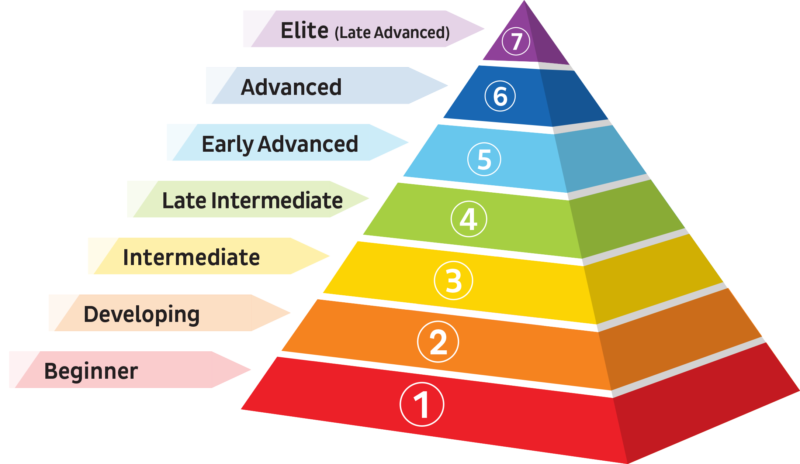
The vast majority of piano students are beginners. This is because EVERYONE who begins piano is, by definition, a beginner! Of those who begin, some drop it immediately, while most others go on towards an early intermediate level (through orange, yellow, maybe to green). Of those, some drop out, and others go on to early advanced. And so on and so on, until there are just a small percentage of students at the elite level.
I realised I should have shown this diagram to James’ mum. 2 Rather than trying to justify my position and thinking I had to validate myself as a teacher, I could simply have said “I specialise in orange through to light blue (tiers 2-5). James is getting towards purple (tier 7), and he will be better off learning from a teacher who specialises in that area.”
I realised something else too, a thought process I now use to silence ‘imposter me’. If all of us experienced teachers held on to students through to tier 7, we would have very little room in our studios for new students at the lower levels. If all teachers preferred advanced students, who would teach the beginners?
I think it is so important to have experienced, knowledgeable teachers who teach the bottom half of the pyramid. We don’t want this part handled wholly by the ‘I’ve-done-5th-grade-piano’ teenager down the road (unless they have a marvellous mentor). So, it does not make me an imposter if I don’t have any advanced students in my studio. I choose to have it this way.
Now I have three questions for you:
- Which tiers of the pyramid do you MOSTLY teach?
- Which tiers do you LOVE to teach?
- Which tiers do you feel you teach BEST?
If the answers to these three questions are the same, then you are specialising in your preferred area! Congratulations!
If your answers differ, perhaps you are suffering from pressure and guilt about having to teach in areas outside your comfort zone. I’m here to tell you that this is not necessary!
You can specialise at any level you wish. If you feel you are lacking the skill to teach a certain level, this can be addressed with professional development, getting a mentor, and practice (both practice of the piano and practice in teaching). If you choose to specialise in the lower levels, that does not necessarily mean that you are incapable of teaching the higher levels.
There is also nothing to say that your comfort zone won’t change over time. Most piano teaching careers tend to span decades, and specialties can evolve. As an example, whilst I usually prefer to take transfer students, I have recently decided that beginners (tier 1) might not be so scary after all. 😊 I have consulted with other teachers who specialise in this field, have acquired more ‘equipment’ like boomwhackers and chimes (which my older students are LOVING, why didn’t I do this before?), and have taken on a couple of young students. I am enjoying it, but it will certainly take a while before I feel like I’m in my comfort zone. It may never become my specialty… and that’s ok.
Finally, a word about passing students on. It can be hard to let go, but if you take time to find just the right teacher for them, it is a very satisfying experience. I do miss James, but I know he is in wonderful hands and that both he and his teacher are enjoying every lesson to the utmost, doing what they love. I’m so looking forward to the day when I hear James in recital, knowing that I played a part in creating this accomplished musician.
- That’s right, I prefer transfer students – pianists who have begun their journey with another teacher. I LOVE the challenge of tuning in to exactly what they’re after, without having to deal with the basics. This means I often have to ‘fix’ some bad habits, but this is also my specialty, and I enjoy it.
- Except that I hadn’t really devised it at the time, hence this blog post.

Thanks for the excellent blog about our teaching specialty. It validates my own past decisions and provides guidance for future choices. Much appreciated!
So glad you found it helpful Roslyn!
Brilliant and colorful solutions that really do calm that inner voice for teachers. Right on!
Thank you Leila!
Thank you! This was well presented. Definitely a good idea to show the graphic to a parent.
We have moved a lot over the course of our lives, and consequently, I’ve never had the opportunity to cross this bridge. I finally have 3 students entering the early intermediate level and am enjoying the new content, but I think that I’ll always enjoy the beginners!
thank you! Céu Mota, Piano Teacher , Portugal
Pingback: Friday Finds #246 - Piano Pantry
Thanks for modelling a positive way to own our strengths. It’s refreshing to have those within reach.
Thank you for the down-to-earth sharing of your own struggles, and challenges in your teaching career, Ms. Samantha Coates. Your candid sharing resonates with me. Indeed, no preschool teacher should feel less qualified than a High School or Tertiary teacher. All students need different levels of teachers to start in life from beginners to tertiary. You did a marvelous thing by referring James to the next teacher who specializes in higher grades. It’s very commendable of you to give James the freedom to develop his musical talent further and not feel caged in. I admire your selflessness as a teacher who loves to see her students grow from strength to strength in their music journey. You are indeed an exemplary and exceptional teacher!
Thank you so much for this wonderful reply!
I really appreciate your sharing this dilemma. I have yet to encounter this as the vast majority of my students quit before finishing level 3 ( so frustrating!) I do have one exception, a teenage girl who has been with me for 7 years and is approaching late intermediate skills. I ‘m fine with her now, but if she were to go much beyond, I believe I would have to “relinquish” her to another teacher…unfortunately that teacher would be an hour’s drive from this town; thus another dilemma. I also have an adult student who has been with me for almost 10 years, progressing from late beginner to late intermediate, so it’s possible, although not probable that I might encounter that situation with her as well. Just know, there are many of us out here and we appreciate your work and your sharing!
It must be so hard when relinquishing a student means more travel for them! 🙁
Hi there Samantha,
Thank you very much for referring to this blog from your recent newsletter (11 Sept 2025). For more than 20 years, the ‘imposter’ idea has invaded my being. This year it has started to fade as I realised my specialty was your red to yellow levels, teaching in groups. As a result of passing on early advanced students to wonderful colleagues in our regional area, great relationships have maintained & even strengthened between parents, students and teachers. We now have a piano competition in its second year. It is a comforting guide, reminding me that is OK and best for my students to move on. Your words here sit so well with me, confirming that I’m OK too. Thank you so much 🙂
You are absolutely right – you are more than ok. I’m so glad the post resonated with you and I thank you for the feedback <3
Thank you so much for sharing this Samantha and being vulnerable about your own teaching. We already know you are a great teacher and moving James onto another teacher has further confirmed that.
I have students at all levels and enjoy them all, however your post has got me thinking and it is something I will definitely be ‘mulling over’!
🙂
Samantha, thank you for sharing. 🙂
Such an important aspect of teaching journey.
We evolve as teachers over the years of experience.
Teaching to advanced level I exactly remember when I was ready to move with my students to the next level.
The work at the higher level is demanding at times but teaching from the start can be equally challenging, because we need to prepare students (technically, musically) for more complex repertoire.
You do a beautiful job with your advanced students Anna!