
Not All Bars Are Equal: A Concerto Update
I’ve been working through the Mozart D minor Concerto K466, and had every intention of following the 12-month AI-generated practice plan I mentioned in my previous post.
I have two updates:
- It is going to take me a lot less than 12 months to learn and memorise this concerto.
- I have not been following the plan.
It has been 3 months so far. I’d say I’ve practised it about 3 times per week1, about 45 mins per session, and I’ve pretty much got my fingers around all the notes in all three movements, and have just started on the cadenzas.
So why have I abandoned the plan? I had already asked AI to exclude from the plan all bars of rest and all bars in which only one had is playing, and I thought it did a good job of creating a process for learning the rest. But as it turns out, AI doesn’t understand that not all bars are created equal.2
The Sight-Readable Bars
Some bars are sight-readable. Sure, I’ll need to work on my tone and make sure they are memorised, but they are written with that gorgeous Mozart simplicity which means you glance at them and your fingers just know what to do.

These passages are friendly, familiar, and often follow predictable harmonic patterns. They require work on balance and finesse, but as for mastering the notes? Hardly any practice required.
The Bars Based On Technical Work
Many passages are based on scales or arpeggios, which are practically second nature if you’ve done AMEB Grade 83 and still have any sort of technique. I was drilled in studies and technical work all my piano playing life, working through the AMEB system, getting my L.Mus aged 16.4
So a passage like this, which looks ominous to all of my students:
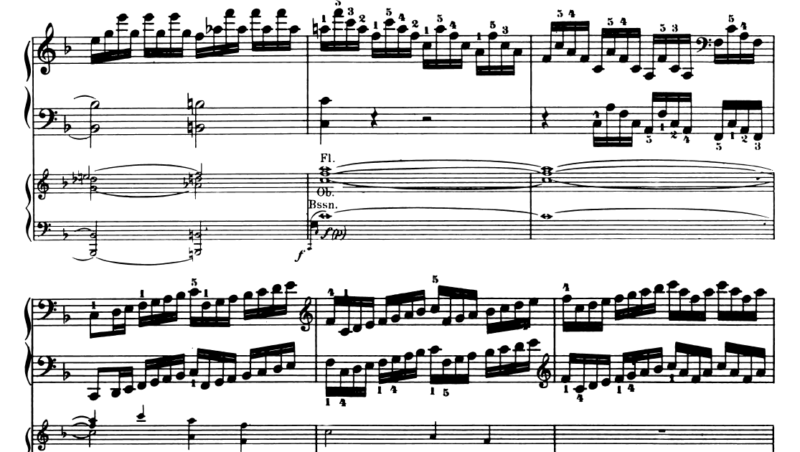
looks (and feels) pretty easy to me. To pianists with solid techniques, these passages are like old friends— easy to master and even easier to memorise.
The Tricky Bars
And then… there are the tricky bars.
The ones that look deceptively simple but feel awkward under the fingers.
For example, I would not have guessed, at first glance, how much grief this passage would cause me

Then there are passages like this one, which require a very specific fingering to avoid disaster.

And the second bar of this one trips me up EVERY SINGLE TIME and I am getting VERY VERY FRUSTRATED

AI doesn’t get any of this, of course. A bar is a bar is a bar. It doesn’t know that some bars are ‘muscle-memory gold’ while others are a challenge both in mental and finger gymnastics.
This is where human musicianship — and experience — comes in. We know which bars need to be prioritised; which ones need constant revisiting and which ones just need a quick polish now and then. Every practice session starts with a triage: some parts need the ICU, some just need a quick X-ray, and some are left waiting, knowing they’ll be ok without attention.
I realised it has been more than 12 years since I have blogged about practising and performing, documenting my own little self-discoveries.
In this 2013 blog, called ‘Deciphering Cesar Franck’, I talk about preparing a very difficult piano accompaniment. Upon reading it back, I realised how different an experience Mozart is. Not even the very trickiest passage in K466 makes me feel like this:
“I have never read such an un-sightreadable accompaniment. Pretty much every phrase had to be deciphered in some way: from complicated accidentals to inner melody lines to compensating with one hand or the other for the impossibly large chords. I actually cried during some practices, when my fingers just would not, could not do it.”
Then a month later I wrote a follow-up blog, Practice will only get you so far. When I read back this one, I definitely had a little giggle. It’s an especially fun read if you have ever played not-as-well-as-you-wanted-to in a performance.5
This process has made me appreciate the process of practice, and has changed the way I talk about practice with my students. It is fun to lead by example, to empathise with them about how tempting it is to just play from the beginning, but how much quicker you learn the piece if you don’t do that. I am continuing to enjoy my practice, and am kind of wishing that the actual performance date wasn’t so far away. Not sure I’ve ever thought that before 😊.
- Don’t tell my students! I’m always saying that three practices per week is not enough! But do I get a pass if the reason I’m not practising is because I’m busy teaching them how to practice???
- Which is fair enough, since AI is not a trained classical pianist.
- Back when I did it, the Australian Music Examinations Board’s Grade 8 piano syllabus was the most gruelling in terms of all the scales and arpeggios that had to be prepared. The diploma exams which followed did not require any technical work at all.
- The irony here is that none of my students have this same trajectory. So, whilst they wouldn’t be able to sit down and easily play through a Mozart concerto, they CAN improvise, compose, and play by ear – which I was never taught to do. But that’s for another blog post.
- Which is everyone.

So many monumental insights! Keep it up, Sam!
Thank you and I will! 🙂
Such a good read, and especially loved the foot notes. A professional harpist friend of mine reminded me after a performance where I was flummoxed after some unusal mistakes, to estimate the amount of notes I got correct! It was a nice little perspective shift! Well, I’m off to practice.